




News
We believe that helping others is the source of happiness. Leveraging our expertise, we are dedicated to solving your industry-specific challenges.
How Split Screen Technology Works on LED Displays
Author: SHENZHEN LONGDA LED CO.,LTD.
Click:
How Split Screen Technology Works on LED Displays?
1. Definition of Split Screen Technology for LED Displays
LED split screen technology divides a full large LED screen into multiple independent display areas from signal or visual dimension. All zones can play identical content synchronously, or output separate videos, images and texts individually. It is widely applied in shopping malls, conference rooms and outdoor advertising screens.
2. Three Main Implementation Methods
1. Hardware Controller Partitioning (Most Widely Used)
Core devices: LED video processor, sending card, multi-output splicing controllerWorking principle:
- Multiple video sources (PC, surveillance cameras, set-top boxes, etc.) connect to the video processor;
- Partition coordinate areas are set in controller software, and each zone is assigned a corresponding video source;
- The processor performs image splitting, scaling and cropping calculations, then distributes processed image data to LED sending cards matched with each zone;
- Sending cards drive corresponding LED cabinet modules, and each zone outputs independent images to realize physical split screen via hardware.
Advantages: Supports arbitrary irregular partitions and free switching of multiple signal sources with high stability. Ideal for large rental screens and commercial LED walls.
2. Software Virtual Split Screen (Small Indoor Screens / Conference Displays)
Realized by multi-output graphics card on PC and LED playback software:
- The PC’s multi-channel graphics card outputs multiple images, and the playback software carries built-in partition canvas function;
- Drag to create multiple virtual windows on the canvas, and load independent materials for each window;
- All image data is transmitted to one single sending card, which splits and renders images to display multi-window split screen effects.
Limitations: All signal sources rely on one single host. Once the host crashes, all zones go black. Suitable for small fixed LED screens.
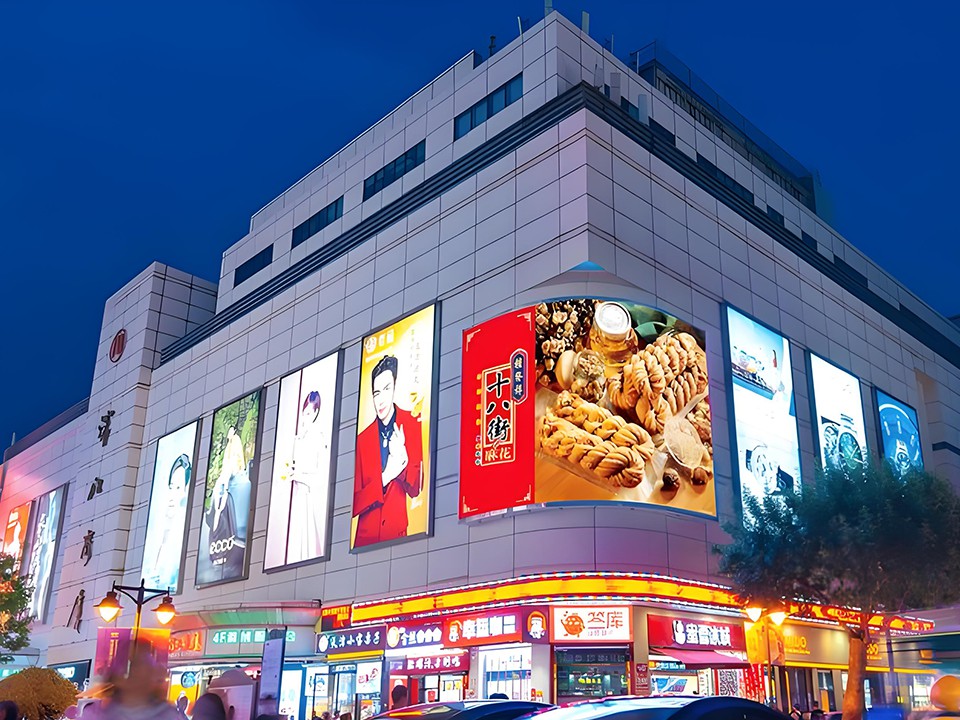
3. Combined Split Screen with Multiple Independent LED Panels
A giant screen assembled by several standalone LED panels with individual sending cards for each unit:
- Every panel receives signals independently and plays separate content;
- Synchronization signals unify refresh rate to avoid color difference and image tearing;
- All panels form a huge split screen visually, and can switch to full-screen unified playback with one click.
Application scenarios: Connected advertising screens in malls, long corridor display walls.

3. Core Underlying Technical Support
- Image scaling algorithm: Adapt partition images to cabinet resolution without stretching or blurriness;
- Synchronous clock technology: Unify refresh rate and gray scale of all zones to prevent lag and image gaps;
- Parallel data transmission: Multi-channel Gigabit Ethernet ports on controllers transmit image data in parallel to meet bandwidth requirements of high-resolution split screens;
- Area coordinate mapping: Software accurately locks the physical position of each partition on the full screen via X & Y axis coordinates.

点击右上角
分享给朋友吧







 Long by picture save/share
0
你的喜欢,就是我坚持写下去的能量器
YouArticle
已有0人推荐
